SecureNexus GRC
SECURENEXUS
  • Home
  • Blog
  • Case Studies
  • About
Get Started
SecureNexus GRCSECURENEXUS

Empowering digital organizations with unified security — through connected insights, trusted expertise, and end-to-end coverage.

A venture of

X-Biz TechVentureswww.xbizventures.com

Services

  • Regulatory Consulting
  • Red Teaming
  • Cloud Security
  • Security Operations
  • Security Training
  • Product Advisory

Products

  • Perimeter (CTEM)
  • Cloud Security Posture Management
  • Vulnerability Management
  • SOVA (SCA)
  • Third Party Risk Management

Company

  • About Us
  • Contact
  • Blog
  • Case Studies

Resources

  • Security Assessment
  • Breach Probability

Contact

[email protected]
+91 1800-266-8575

Certifications & Compliance

Certifications and Empanelment — D.U.N.S Registered, ISO 9001:2015, BQC, IAF, ISO 27001, Nasscom, ESC, CERT-IN Empanelled
Offices

Mumbai (HQ)

118-120 IJMIMA Complex, Mindspace, Malad West, Mumbai 400064

Pune (GCC)

Unit 2-B, 1st Floor, Cerebrum IT Park, Kalyani Nagar, Pune 411014

Mumbai (Tech & Innovation)

315, 3rd Floor, Lodha Supremus, Andheri East, Mumbai 400069

Dubai

M35, Warba Centre, Al Muraqqabat, Deira, Dubai

X-Biz TechVentures

© 2026 X-Biz TechVentures Pvt. Ltd. All rights reserved.

SecureNexus

Security Intelligence

Expert analysis on threats, compliance, and the evolving security landscape.

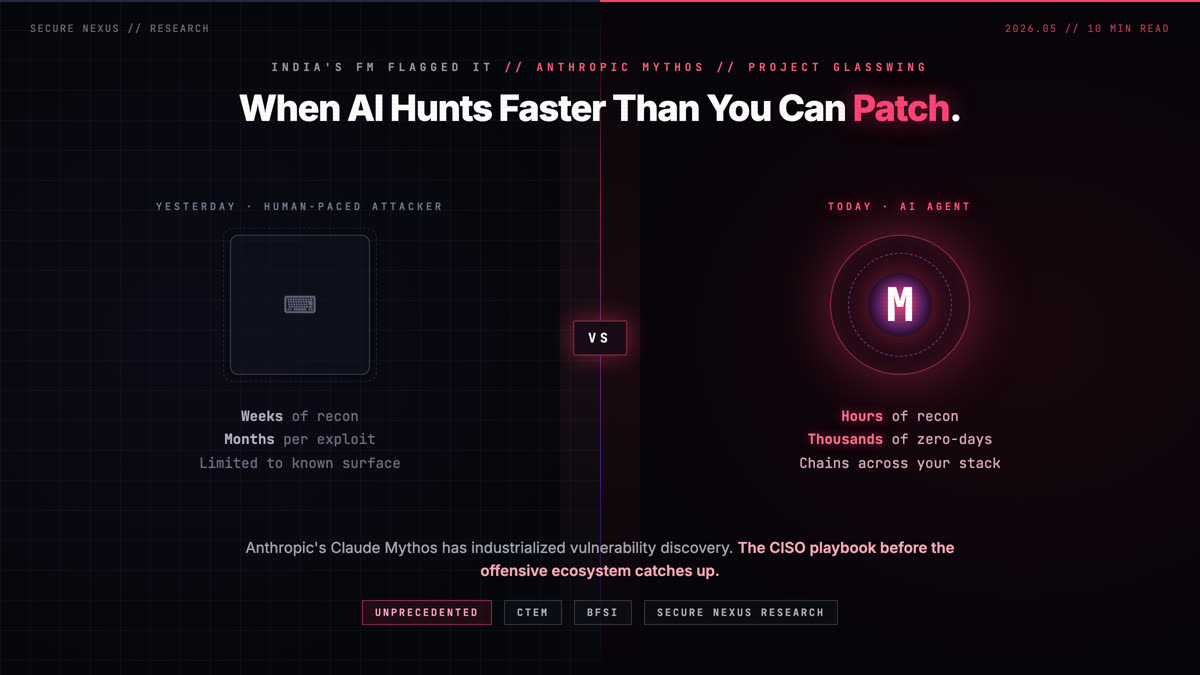
India's Finance Minister Has Flagged Anthropic's Mythos as Unprecedented — Here's the CISO Playbook for AI-Driven Vulnerability Hunting
Security
2026-05-01·10 min read·By Sunil Yadav

India's Finance Minister Has Flagged Anthropic's Mythos as Unprecedented — Here's the CISO Playbook for AI-Driven Vulnerability Hunting

India's Finance Minister Nirmala Sitharaman has flagged Anthropic's Claude Mythos as an unprecedented cybersecurity threat to the banking sector and directed IBA-led hardening with CERT-In intelligence sharing. Mythos has already autonomously discovered thousands of zero-days across every major OS and browser at trivial cost. This is the preemptive playbook every CISO needs to run before similar capabilities reach the offensive ecosystem.

Topics

26 articles

The Publish Pipeline Is the New Attack Surface: Lessons from the Bitwarden Workflow Incident
Security

2026-04-23 · 8 min read

The Publish Pipeline Is the New Attack Surface: Lessons from the Bitwarden Workflow Incident

On April 22, 2026, a malicious version of @bitwarden/[email protected] was published to npm through a compromise of Bitwarden's own publishing workflow. The exposure window was approximately 93 minutes (5:57 PM to 7:30 PM ET). Bitwarden confirmed the compromise was connected to the ongoing Checkmarx supply chain incident disclosed the same day. End-user vault data, production systems, and the legitimate Bitwarden codebase were not impacted; only users who installed @bitwarden/[email protected] from npm during that narrow window were potentially affected. This post covers what Bitwarden has officially confirmed, the response steps for affected teams, and the broader lesson that CI/CD publishing pipelines are themselves the attack surface.

By Yash Kumar

Inside forge-jsx: Anatomy of a Multi-Platform npm RAT Masquerading as an Autodesk Forge SDK
Security

2026-04-20 · 10 min read

Inside forge-jsx: Anatomy of a Multi-Platform npm RAT Masquerading as an Autodesk Forge SDK

npm package [email protected] — marketed as a Node.js integration layer for Autodesk Forge — is a multi-platform RAT and infostealer. This technical breakdown walks through the postinstall kill chain, the LaunchAgent/systemd/Task Scheduler persistence primitives, the .env and shell-history harvesting modules, and the AES-256-GCM-obfuscated C2 blob, with SecureNexus SOVA analysis evidence.

By Yash Kumar

The Protocol No One Secured: How Anthropic’s MCP Turns AI Agents into Remote Execution Engines
Security

2026-04-20 · 5 min read

The Protocol No One Secured: How Anthropic’s MCP Turns AI Agents into Remote Execution Engines

Anthropic’s MCP introduces a critical design flaw where AI agents can execute actions based on untrusted tool responses. This turns AI systems into unintended remote execution engines, exposing risks like RCE, data leaks, and full workflow compromise. The issue isn’t a bug—it’s a broken trust model requiring a shift to secure, zero-trust AI architectures.

By Arjun Gupta

Your Frontend Is a Goldmine: Hidden Secrets in JavaScript Bundles
Security

2026-04-11 · 9 min read

Your Frontend Is a Goldmine: Hidden Secrets in JavaScript Bundles

Minification isn't encryption. Every JavaScript bundle your app ships is readable in seconds — and attackers know it. This post breaks down exactly what they find: hardcoded API keys, internal endpoints, client-side business logic, and exposed source maps. Plus the five controls that make sure none of it leaves your codebase.

By Arjun Gupta

Post-Install Scripts: The Most Dangerous Feature Nobody Talks About
Security

2026-04-10 · 8 min read

Post-Install Scripts: The Most Dangerous Feature Nobody Talks About

Every npm install silently executes lifecycle scripts from every package in your dependency tree — no prompts, no sandboxing, with full system access. This post breaks down how post-install scripts work, why they are the most exploited vector in npm supply chain attacks, and the five controls that eliminate the risk.

By Arjun Gupta

GlassWorm's Zig Dropper: Why Every IDE Is Now Part of the Attack Surface
Security

2026-04-10 · 10 min read

GlassWorm's Zig Dropper: Why Every IDE Is Now Part of the Attack Surface

GlassWorm is a multi-ecosystem supply chain campaign that embeds invisible Unicode-obfuscated payloads in GitHub repositories, npm packages, and VS Code extensions. Its latest evolution uses a Zig-compiled native dropper to spread across developer IDEs, harvesting credentials and enabling autonomous supply chain propagation. This analysis breaks down the infection chain, explains why the IDE is now a Tier-0 attack target, and provides actionable controls for security teams.

By Vitish Bhardwaj

VeloraDEX SDK Poisoned: Anatomy of an npm Supply Chain Attack Targeting DeFi Developers
Security

2026-04-08 · 12 min read

VeloraDEX SDK Poisoned: Anatomy of an npm Supply Chain Attack Targeting DeFi Developers

On April 7, 2026, a malicious version of the VeloraDEX SDK — the JavaScript library used by DeFi applications to aggregate liquidity across decentralized exchanges — was published to npm. Version 9.4.1 of @velora-dex/sdk contained a three-line payload prepended to the bundled distribution file that silently downloaded and executed a remote bash script from a server in Romania. The malicious code was not present anywhere in the GitHub repository. Only the npm tarball carried the backdoor, and it ran on every import — no install hooks, no postinstall scripts, nothing that conventional security scanners flag. For a package that sits in the dependency tree of DeFi applications handling real money, this is about as dangerous as supply chain attacks get.

By Sunil Kumar

Axios Compromised: Anatomy of an npm Supply Chain Attack
Security

2026-03-31 · 15 min read

Axios Compromised: Anatomy of an npm Supply Chain Attack

I spent the morning of March 31, 2026 pulling apart what turned out to be one of the more carefully orchestrated npm compromises I have seen. Someone hijacked a lead maintainer's account for axios — the HTTP client that 174,000+ packages depend on — and pushed two rogue versions containing a hidden dependency. That dependency carried an obfuscated postinstall script that dropped a cross-platform RAT, phoned home to a command server, then erased every trace of itself from disk. The whole operation ran for about three hours before npm pulled the versions, but three hours is an eternity when you are talking about a package at the foundation of the JavaScript dependency graph.

By Vitish Bhardwaj

TeamPCP Strikes Again: PyPI Supply Chain Breach Turns Telnyx SDK Into a Credential Stealer
Security

2026-03-27 · 12 min read

TeamPCP Strikes Again: PyPI Supply Chain Breach Turns Telnyx SDK Into a Credential Stealer

On March 27, 2026, two malicious versions of the Telnyx Python SDK (4.87.1 and 4.87.2) were uploaded to PyPI using stolen credentials linked to the TeamPCP threat group. The payload used WAV steganography to hide credential-stealing malware inside audio files. PyPI quarantined both versions within six hours, but the package's 742,000+ monthly downloads meant significant exposure.

By Mohit Kumar

Page 2 of 3

13