
Why vulnerability management alone isn't cutting it anymore and how CTEM gives security leaders a framework to continuously discover, prioritise, and remediate real exposure across sprawling attack surfaces, not just chase CVE counts.
Why CTEM Is Becoming the Backbone of Modern Security Programs
The Problem Nobody Wants to Admit
Here's a scenario that plays out more often than anyone in security leadership wants to acknowledge: a company runs quarterly vulnerability scans, patches critical CVEs within SLA, passes its annual audit — and still gets breached through an internet-facing asset nobody knew existed.
The attacker didn't use a zero-day. They didn't need one. They found a forgotten staging server, chained a known vulnerability with a misconfigured cloud storage bucket, and walked straight into production data. The vulnerability had been flagged in a scan three months earlier — on a different asset, in a different context, where it scored a medium severity.
This is the gap that Continuous Threat Exposure Management (CTEM) was built to close. Not another scanning tool. Not another dashboard. A fundamentally different way of thinking about what "secure" actually means when your attack surface changes faster than your remediation cycles.
Why Vulnerability Management Alone Stopped Working
Traditional vulnerability management made perfect sense when organisations had a relatively fixed perimeter: a data centre, a known set of servers, a managed fleet of endpoints. You scanned, you prioritised by CVSS, you patched, you reported. Done.
That model broke down gradually, then all at once.
The average enterprise today has thousands of internet-facing assets spread across cloud providers, SaaS platforms, third-party integrations, APIs, container orchestration layers, and developer infrastructure. Many of these assets are spun up by engineering teams without security's knowledge. Some are legacy systems quietly running behind outdated load balancers. Others are vendor-managed services where patching isn't even in your control.
Vulnerability scanners see what you point them at. They don't know about the subdomain your marketing team launched on a personal AWS account. They don't correlate a low-severity misconfiguration in your CDN with a medium-severity API flaw that, chained together, gives an attacker access to customer PII. And they certainly don't tell you which of your 14,000 open findings actually matter given what's reachable from the internet right now.
This isn't a tooling failure. It's a model failure. Vulnerability management answers "what's vulnerable?" — but that's the wrong question. The right question is "what's exposed, exploitable, and worth an attacker's time?"
That's the question CTEM answers.
What CTEM Actually Is (and Isn't)
Gartner formalised the CTEM framework in 2022, but the operational logic behind it had been emerging from mature security teams for years. The core idea is straightforward: instead of managing vulnerabilities in isolation, you continuously discover, assess, and prioritise your organisation's actual threat exposure — across your entire attack surface, not just the assets you already know about.
CTEM operates in five stages: Scoping, Discovery, Prioritisation, Validation, and Mobilisation. Each stage addresses a specific failure mode in traditional security programs.
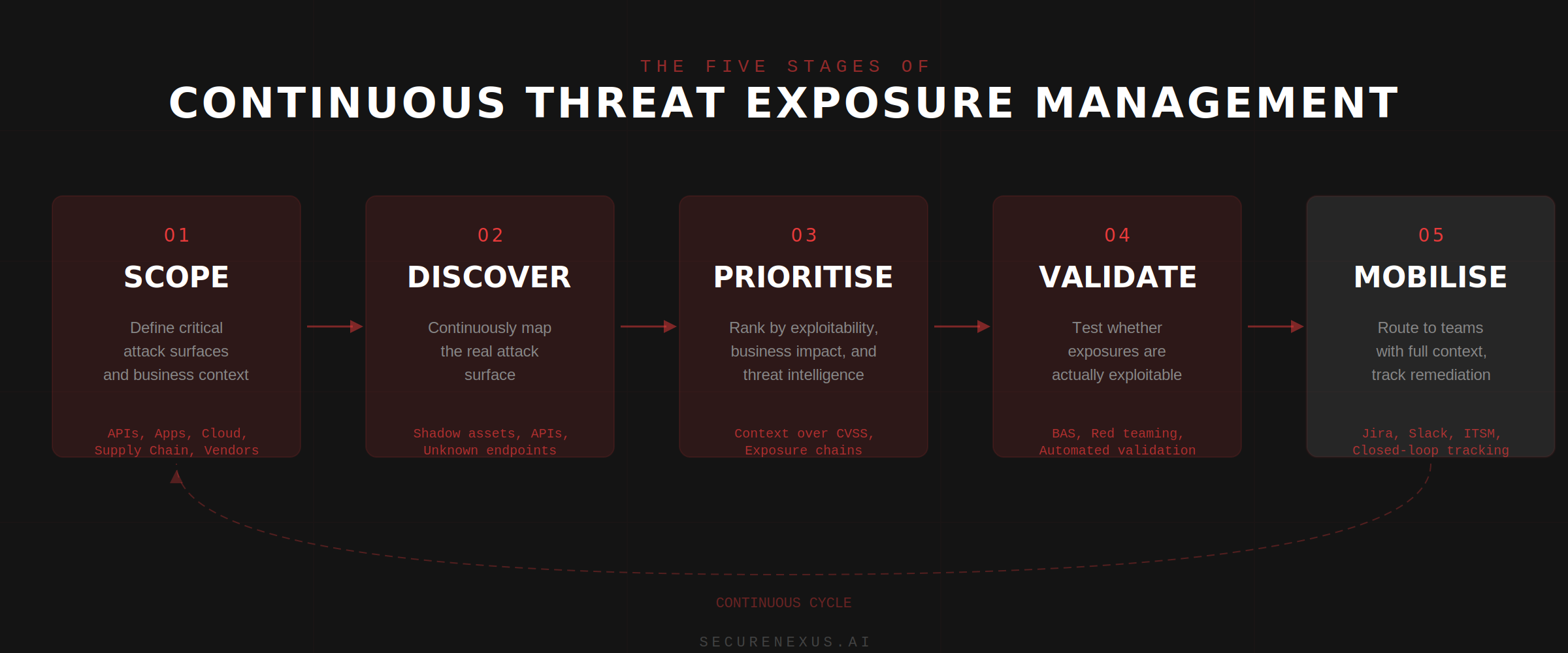
Scoping forces the question most programs skip: what are we actually trying to protect, and from whom? This isn't a checkbox exercise. It means defining exposure scope in terms of business-critical attack surfaces — not just IP ranges. External-facing applications, API endpoints, cloud workloads, supply chain dependencies, third-party integrations — all of it.
Discovery goes beyond scanning. It's about continuously mapping the real attack surface, including assets you didn't provision, shadow APIs your developers built, and infrastructure your vendors exposed on your behalf. This is where attack surface management platforms like SecureNexus ASM earn their keep — they continuously enumerate internet-facing assets, detect shadow infrastructure, and surface exposure that traditional asset inventories miss entirely.
Prioritisation is where CTEM diverges most sharply from legacy approaches. Instead of ranking findings by CVSS score alone, CTEM prioritises based on exploitability, exposure context, business impact, and threat intelligence. A CVSS 6.5 vulnerability on an internet-facing API that handles payment data is a far more urgent problem than a CVSS 9.8 on an internal dev server behind three layers of network segmentation. Platforms like SecureNexus CTEM operationalise this by correlating findings across ASM, vulnerability data, cloud posture, and threat intelligence — so security teams see prioritised exposures rather than undifferentiated finding lists.
Validation means testing whether the exposure is actually exploitable. This can involve automated validation, breach and attack simulation, or targeted red team exercises. The point is to eliminate false positives and confirm that the prioritised risks are real — not theoretical.
Mobilisation is the step most frameworks forget: actually getting findings remediated. This means routing validated exposures to the right teams with enough context that they can act, tracking remediation progress, and closing the loop. It's not glamorous, but it's where exposure management programs succeed or die.
How This Plays Out in Practice
Consider a mid-size financial services company — let's call it a digital lending platform — running a hybrid infrastructure across AWS, Azure, and an on-premise data centre. They've got a mature vulnerability management program: Qualys scans running weekly, Jira tickets for anything critical, monthly reporting to the board.
Their CISO decides to pilot a CTEM approach after a near-miss incident where a researcher disclosed an exposed Kubernetes dashboard they didn't know existed.
In the scoping phase, they define three priority attack surfaces: customer-facing lending applications, payment processing APIs, and third-party data integrations with credit bureaus. This immediately reveals a gap — their existing scans don't cover the API layer or third-party connection points at all.
During discovery, the ASM component identifies 340 internet-facing assets. Their CMDB listed 210. The delta includes forgotten staging environments, a test API gateway with production credentials, and two subdomains pointing to a decommissioned vendor's infrastructure — still resolving, still reachable.
Prioritisation collapses their 8,200 open vulnerability findings into 47 validated exposures that are internet-reachable, exploitable with known techniques, and connected to business-critical data flows. Forty-seven. Not eight thousand. This is the moment CISOs start paying attention, because suddenly remediation isn't a resource allocation nightmare — it's a focused sprint.
Validation confirms that 31 of the 47 exposures are exploitable in their current configuration. Twelve of those allow data access. Three provide a path to lateral movement into the payment processing environment.
Mobilisation routes those 31 findings — with full attack path context, business impact assessment, and suggested remediation steps — directly to the responsible engineering teams. Not a CSV dump. Not a Jira ticket with a CVSS score and a link to the NVD. Actual operational context that explains why this finding matters and what happens if it's exploited.
The entire cycle took two weeks. Their previous quarterly scan-and-patch cycle would have flagged some of these issues eventually — buried in a spreadsheet alongside thousands of other findings, stripped of context, and competing for engineering bandwidth against feature development.
Why Security Leaders Are Making CTEM Central
Three forces are converging to push CTEM from "interesting framework" to "operational necessity."
First, attack surfaces are growing faster than security teams. Cloud adoption, API-driven architectures, and software supply chain dependencies mean the average organisation's exposure footprint expands continuously. You can't secure what you can't see, and traditional asset management can't keep pace. Continuous discovery — the kind that ASM platforms provide — isn't optional anymore. It's the foundation.
Second, attackers think in exposure chains, not individual CVEs. Real-world breaches almost never involve a single vulnerability exploited in isolation. They involve chains: a misconfigured S3 bucket leads to leaked credentials, which unlock an API that exposes a database. Vulnerability scanners see each link in isolation. CTEM sees the chain. SecureNexus CTEM's exposure correlation engine is built around this principle — connecting findings from ASM, cloud posture (via SecureNexus CSPM), vulnerability scans, and threat intelligence into unified exposure views that reflect how an attacker would actually approach the environment.
Third, boards and regulators are asking harder questions. "How many critical vulnerabilities do we have?" is being replaced by "What is our actual exposure to the threats targeting our industry?" CTEM gives CISOs an answer to that question — one grounded in validated, prioritised, business-contextualised exposure data rather than raw vulnerability counts.
Detection and Continuous Response
Implementing CTEM isn't a single tool purchase. It's an operational shift that requires integrating several capabilities:
Continuous attack surface discovery that goes beyond known asset inventories. This means monitoring for new subdomains, exposed cloud services, shadow APIs, and third-party infrastructure changes. SecureNexus ASM handles this layer, feeding discovered assets into the broader exposure management workflow.
Exposure correlation and prioritisation that factors in exploitability, reachability, business context, and active threat intelligence. This is where CTEM platforms differentiate from glorified vulnerability dashboards. The output should be a prioritised queue of validated exposures — not a 200-page PDF of scan results.
Supply chain visibility for organisations where software dependencies and vendor integrations represent significant exposure. Understanding what's in your software — SBOMs, CBOMs, dependency trees — and whether those components carry known risks is increasingly part of the exposure picture. SecureNexus SOVA addresses this by providing orchestrated supply chain visibility across open-source and third-party software components.
API discovery and posture management, because APIs are now the primary attack surface for most modern applications, and most organisations don't have a complete inventory of their API endpoints — let alone visibility into authentication, authorisation, and data exposure across those endpoints. SecureNexus API POS continuously discovers and assesses API posture as part of the broader exposure management picture.
Remediation tracking and mobilisation that integrates with existing engineering workflows. The best exposure data in the world is useless if it sits in a security dashboard nobody checks. Findings need to flow into the tools engineering teams actually use — with context attached.
Key Takeaways
- Vulnerability management tells you what's broken. CTEM tells you what's exploitable. The shift from "findings" to "validated exposures" is the single most impactful change a security program can make to reduce actual risk.
- Discovery is the foundation, not scanning. If you don't know about an asset, you can't scan it, you can't patch it, and you definitely can't defend it. Continuous attack surface discovery is step zero.
- Prioritisation without business context is noise. CVSS scores alone don't tell you what matters. Exploitability, internet reachability, data sensitivity, and active threat targeting do.
- CTEM is a program, not a product. The framework requires integration across ASM, vulnerability management, cloud posture, threat intelligence, and remediation workflows. No single tool delivers CTEM out of the box — but platforms that unify these capabilities under a single correlation engine dramatically reduce the operational burden.
- Start with scoping, not scanning. Define what matters before you start measuring what's wrong. The organisations getting the most value from CTEM are the ones that began by mapping their critical business attack surfaces — not by deploying another scanner.
The Bigger Picture
CTEM isn't a revolution. It's the natural evolution of security programs that have outgrown the scan-patch-report cycle. The organisations adopting it aren't doing so because a Gartner report told them to — they're doing it because their existing approach wasn't preventing breaches, wasn't giving leadership actionable answers, and wasn't scaling with their infrastructure.
The backbone of a modern security program isn't any single tool. It's the operational discipline to continuously understand your real exposure, validate what matters, and mobilise remediation where it counts. CTEM provides the structure to do exactly that — and for security teams drowning in findings but starving for clarity, that structure is long overdue.
About the Author
Yash Kumar is a Lead in Research & Innovation, focused on exploring emerging technologies and turning ideas into practical solutions. He works on driving experimentation, strategic insights, and new initiatives that help organizations stay ahead of industry trends.